
Your air conditioner is humming, the fan is blowing, but the air coming out isn’t cold. This guide covers every real cause, from the simple fixes you can do in 5 minutes to the issues that need a technician.
An AC that runs but doesn’t cool is most commonly caused by a clogged air filter blocking airflow, a dirty outdoor condenser that can’t release heat, low refrigerant from a leak, or frozen evaporator coils. Start by replacing the filter. If the problem continues after 2–3 hours, check the outdoor unit and call a technician if you suspect a refrigerant issue or frozen coils.
📋 What’s In This Guide
- 9 Causes: AC Running But Not Cooling
- Step-by-Step DIY Checks
- Thermostat Problems
- Clogged Air Filter
- Dirty Outdoor Unit
- Low Refrigerant (Gas)
- Frozen Evaporator Coils
- Condensate Drain Clog
- Capacitor / Fan Motor Failure
- Undersized AC Unit
- The 3-Minute Rule Explained
- How to Properly Reset Your AC
- When to Call a Pro
- People Also Ask (FAQ)
There’s a specific kind of frustration that comes with an AC that’s clearly working, you can hear it, the fan is blowing, the unit outside is running, but the air just isn’t cold. Unlike a system that’s completely dead, a running but not cooling AC gives you just enough false hope to be annoying.
The good news: the causes are well-understood, and several of them you can fix yourself in under 30 minutes without any tools. We’ll go through every real cause, from the most common to the more serious, so you know exactly what you’re dealing with before picking up the phone.
The 9 Real Causes
| Cause | What You’ll Notice | Fix Type | Urgency |
| Wrong thermostat setting | Fan blows but air isn’t cool | DIY | Immediate |
| Clogged air filter | Weak airflow, warm air, ice on coil | DIY | Immediate |
| Dirty outdoor condenser | AC runs constantly but barely cools | DIY | Soon |
| Low refrigerant (leak) | Warm air, hissing sound, ice on lines | Pro Only | Urgent |
| Frozen evaporator coil | Little to no air from vents, ice visible | DIY + Pro | Urgent |
| Clogged condensate drain | System shuts off automatically, water in pan | DIY | Soon |
| Failed capacitor / fan motor | Outdoor unit hums but fan doesn’t spin | Pro Only | Urgent |
| Ductwork leaks | Some rooms cool fine, others don’t | Pro Only | When possible |
| Undersized unit | Runs constantly, never reaches set temp | Pro Only | Plan ahead |
1. The 5-Minute DIY Checklist
Before anything else, run through these checks. They take five minutes and resolve more “AC failures” than most people expect, including some that would have resulted in an unnecessary service call.
- Thermostat set to COOL (not FAN or HEAT) — Fan mode blows air without cooling it. This is the single most commonly missed setting.
- Set temperature is lower than room temperature — Setting 74°F in a 72°F room won’t trigger the cooling cycle at all.
- Fan set to AUTO, not ON — AUTO only runs the fan when actively cooling. ON runs it all the time, blowing uncooled air.
- Air filter is not clogged — Pull it out and look. If you can’t see light through it clearly, replace it.
- Circuit breaker hasn’t tripped — Look for a breaker in the middle position (not fully ON or OFF). Reset it once only.
- Outdoor unit fan is spinning — A humming unit with a stationary fan means a failed capacitor, a quick pro fix, but it needs one.
- No standing water in the drain pan — Water in the pan triggers the automatic safety shutoff. Clear the drain line to restore operation.
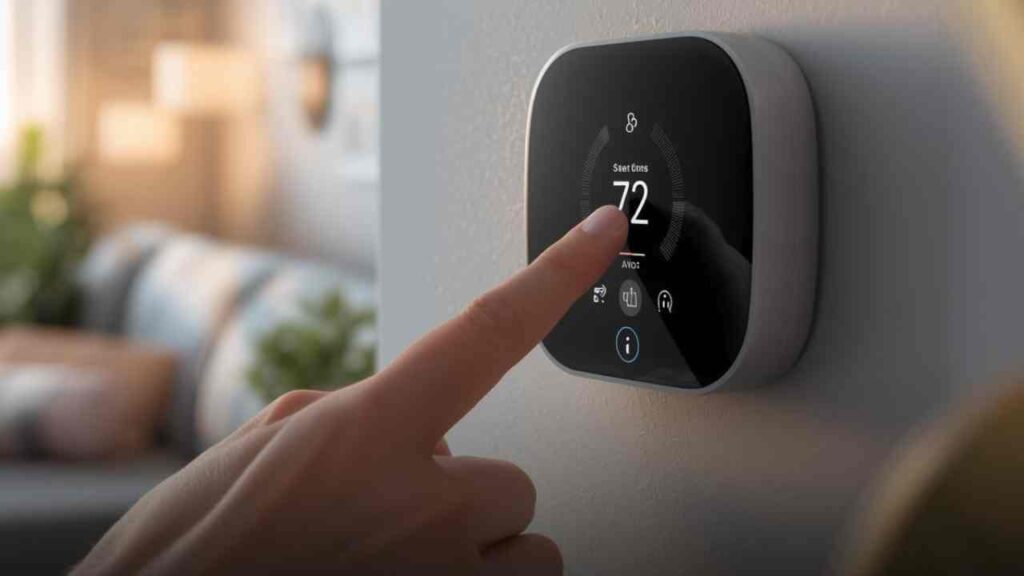
2. Thermostat Settings (The Overlooked Fix)
Thermostat issues cause more “no cold air” calls than any single mechanical problem. Before assuming something is broken, check these four specific things:
Fan set to ON instead of AUTO.
When the fan is set to ON, it runs continuously, even when the system isn’t actively in a cooling cycle. This circulates air through your home, but that air was never cooled. It’s warm air moving fast. Set it to AUTO and the fan only runs when the AC is actively cooling.
Set temperature isn’t below room temperature.
If your room is 72°F and you’ve set the thermostat to 74°F, the system has no reason to cool. It’s already at or below target. Drop the set point 3–4 degrees below what you want and give it 10 minutes.
Smart thermostat schedule override.
If you have an Ecobee, Nest, or similar smart thermostat, check the app. Vacation modes or programmed schedules can override manual settings, and many people set a vacation schedule, forget about it, and wonder why the house is warm.
Dead or weak batteries.
Even if the display looks normal, a low battery can cause erratic behavior including missed cooling cycles. Replace them as a first step even if it seems unlikely.
✅ DIY Fix
Set thermostat to COOL mode, fan to AUTO, and set point to at least 3°F below current room temp. Replace batteries. Check any app for schedule conflicts. Wait 10 minutes.
3. Clogged Air Filter
A dirty air filter is the most common cause of an AC that blows warm air or barely cools. Here’s why it matters more than most people realize.
Your AC’s evaporator coil, the component inside that actually cools the air, requires a constant, steady flow of warm air passing over it. When the filter is heavily clogged, that airflow drops drastically. Without enough air moving across the coil, two things happen: heat transfer is blocked (so the air that does come out isn’t cooled effectively), and the coil itself can start to freeze, which eventually blocks all airflow entirely and shuts the system down.
According to HVAC engineers, a dirty or clogged filter is one of the most frequent reasons for cooling inefficiency, since it restricts the clean airflow the system depends on. Filters should be cleaned or replaced at minimum every 90 days, every 60 days if you have pets in the house.
✅ DIY Fix
Pull the filter out and hold it up to light. If you can’t see clearly through it, replace it immediately. If you suspect the system already froze up, turn it OFF (or to FAN only) for 2–3 hours to thaw before turning cooling back on with the new filter installed.
Watch Out
Don’t close vents in unused rooms thinking it saves energy, it has the same effect as a clogged filter. Your system is designed to push air through a calculated amount of space. Closing multiple vents creates excess pressure that stresses the system and reduces efficiency.
4. Dirty Outdoor Condenser Unit
Your outdoor unit doesn’t pull in cold air, it does the opposite. It takes the heat collected from inside your home and dumps it outside. That process only works if the outdoor coils can breathe freely.
When the condenser coils get coated in dirt, grass clippings, leaves, or cottonwood fuzz, they can’t release heat effectively. The system ends up recycling heat back into itself, making your home feel like the AC is running at half power even though it’s technically working fine.
The outdoor unit needs at least 8–10 feet of clear space around it. Any shrubbery, fencing, or debris within that radius restricts airflow. The coil fins that wrap around the unit need to be clean enough to allow air to pass through them freely.
✅ DIY Fix
Turn the system off. Clear any leaves, grass, or debris from around and on top of the unit. Using a garden hose on a gentle setting, rinse the coil fins from the inside out (top to bottom). Do not use a pressure washer, the fins are delicate and bend easily. Let it dry for 30 minutes before restarting.
5. Low Refrigerant (Gas Leak)
Refrigerant is the chemical that makes cooling physically possible. It circulates between the indoor and outdoor unit, absorbing heat from inside your home and releasing it outside through a continuous cycle of evaporation and condensation.
When refrigerant levels drop, always because of a leak, not because it gets “used up”, the system loses its ability to absorb heat. The result is air that’s slightly cool but never reaches your set temperature, or air that barely cools at all despite the system running constantly.
Signs you have a refrigerant leak:
- Ice forming on the refrigerant lines going into or out of the unit
- A hissing or bubbling sound from the lines or indoor unit
- AC runs for long periods but the temperature barely drops
- Unusually high electric bills for the amount of cooling you’re getting
Important: Turn It Off
If you suspect a refrigerant leak, turn the system off immediately. Running the AC in a low-refrigerant state causes the compressor to work without proper lubrication, leading to what’s called “slugging”, a condition that can destroy the compressor permanently. A compressor replacement can cost $1,500–$2,800. The refrigerant recharge itself is far cheaper.
Note: refrigerant handling requires EPA certification. This is not a DIY repair; a technician must locate and repair the leak before recharging the system. Simply topping up refrigerant without fixing the leak is a temporary measure that will fail again.
6. Frozen Evaporator Coils
A frozen evaporator coil is one of the more counterintuitive AC problems: the part that’s supposed to cool the air gets so cold it turns into a block of ice, and then stops working entirely because ice blocks all airflow through it.
Two things cause this: severely restricted airflow (usually a clogged filter) and low refrigerant. In both cases, the coil gets too cold because it’s not absorbing enough heat from the air passing over it, and the moisture in the air around it freezes solid.
How to tell if your coil is frozen:
Open the panel on your indoor air handler and look at the indoor unit. If you see ice anywhere, on the coil itself, on the copper refrigerant lines, or on the sheet metal around it, the coil is frozen. The system may still be running, but very little or no air will come from the vents.
✅ What To Do
Turn the system to FAN ONLY (or OFF) and let it thaw completely, this takes 2–4 hours depending on how much ice has built up. Do not use heat guns or sharp objects to speed this up. Replace the air filter once it’s thawed. If the coil freezes again after you restart, the cause is likely low refrigerant and requires a technician.
7. Clogged Condensate Drain Line
Your AC removes humidity from the air as part of the cooling process. That moisture condenses into water, drips into a drain pan, and flows out through a condensate drain line, usually a PVC pipe that exits through a wall or near the outdoor unit.
When algae, mold, or debris clogs this line, the water backs up into the drain pan. Modern AC systems have a float switch in the pan that automatically shuts the entire system down when water reaches a certain level, specifically to prevent water damage to your home. This safety feature works exactly as designed, but from the outside it looks like your AC just randomly stopped working.
How to check:
Look at the drain pan beneath your indoor air handler. If there’s standing water in it, the drain is clogged.
✅ DIY Fix
Use a wet/dry shop vacuum applied to the drain line outlet (usually where the PVC pipe exits the house) to pull the clog out. Alternatively, slowly pour a cup of distilled white vinegar into the drain line access port (the T-shaped opening near the air handler) to break up algae buildup. Once the drain is clear and the pan is empty, the float switch resets and the system should restart normally. Pour a cup of vinegar into the drain line monthly to prevent future clogs.
8. Failed Capacitor or Fan Motor
If you go outside and find the outdoor unit is humming but the fan on top isn’t spinning, you very likely have a failed run capacitor. The capacitor is an electrical component that provides the startup energy boost the fan motor and compressor need to begin running. When it fails, the motor either can’t start at all or can’t maintain the energy to keep running.
This is one of the more common AC repairs, especially in systems over 5–10 years old and in hot climates where the capacitor is under constant stress. The capacitor itself is a relatively inexpensive part ($15–$40 for the component), though you’re paying for the diagnostic and labor when a technician replaces it.
Don’t Run a Humming-Only Unit
If the outdoor unit is humming but the fan isn’t moving, turn the system off. The compressor generates enormous heat during operation, without the fan moving air through the unit, it will overheat and can suffer permanent damage within minutes. This is worth an emergency service call to avoid.
9. Undersized AC Unit
This cause is different from the others because there’s nothing broken, the system is working exactly as it was designed to, it just wasn’t designed correctly for your space.
AC cooling capacity is measured in tons and BTUs. A general rule is approximately 12,000 BTUs (1 ton) per 400–600 sq ft, though insulation quality, ceiling height, window area, and local climate all affect the real number. An undersized system will run constantly, never reach the set temperature, and accumulate faster wear on the compressor.
If your AC has always been slightly inadequate, especially if you’ve recently renovated, added square footage, or moved to a warmer climate, this could be the root issue. An HVAC technician can perform a Manual J load calculation to determine the correct size for your home.
⚠️ Note on Extreme Heat Days
Every AC has a design temperature, the outdoor temperature it was sized to handle. When outdoor temps exceed that ceiling (typically 92–95°F in most regions), a properly-sized system will still struggle to reach the set point. If your AC only falls short on extreme heat days, you may not have a problem, just a physical limitation of the system under extreme conditions.
The 3-Minute Rule: What It Is and Why It Matters
The 3-minute rule is one of those small HVAC guidelines that most homeowners have never heard of, but which HVAC technicians consider genuinely important for compressor longevity.
The rule: after turning your air conditioner off, wait at least 3 minutes before turning it back on.
Here’s what’s actually happening inside the system during those 3 minutes: when your AC is running, refrigerant circulates through the system under different pressures, high pressure on one side, low pressure on the other. When you shut the system off, that pressure differential doesn’t instantly equalize. The refrigerant pressure takes a few minutes to stabilize to a balanced state throughout the lines.
If you restart the compressor before that pressure equalizes, the compressor has to start against high refrigerant pressure, essentially like trying to start a car engine while it’s already in high gear. This creates mechanical stress and electrical strain. Over time, repeated hard starts like this degrade the compressor windings and bearings, shortening its service life significantly.
Most modern systems have built-in time-delay relays that automatically enforce this pause, even if you flip the switch immediately, the system waits. But older systems, or any manual breaker reset, may not have this protection.
✅ Apply It In Practice
Any time you reset the circuit breaker, switch the system off, or experience a power flicker: wait at least 3 minutes before turning it back on. This is especially important after power outages, where the temptation is to immediately restore everything. Those 3 minutes are protecting your compressor, the most expensive part of the system.
How to Properly Reset Your AC
A proper reset can clear fault states in the control board and resolve intermittent electronic issues. Here’s the correct sequence:
- Turn the system OFF at the thermostat
- Go to the circuit breaker panel and turn off both breakers, the air handler (indoor) and the compressor (outdoor). Systems have two separate breakers.
- Wait a full 30 seconds minimum, ideally 3 minutes for the compressor
- Turn the air handler breaker back on first
- Wait 30 seconds, then turn the compressor breaker on
- Go to the thermostat and set it back to COOL
- Give the system 10–15 minutes to reach steady operation before judging whether it’s working
If the Breaker Trips Again
Reset a tripped breaker once only. If it trips again within a few minutes, stop resetting it. A repeatedly tripping breaker indicates a real electrical fault — a compressor drawing excess current, a shorted component, or wiring damage. Each reset attempt risks more damage. Call a technician.
When to Stop Troubleshooting and Call a Pro
If your AC is running but not cooling, call an HVAC technician after you’ve worked through the DIY steps above.
- The circuit breaker trips repeatedly after resetting
- You see ice on refrigerant lines, the indoor coil, or the outdoor unit
- The outdoor unit hums but the fan doesn’t spin
- You hear hissing, bubbling, grinding, banging, or screeching
- The system runs for hours and the temperature never drops more than 1–2 degrees
- There is water pooling near or under the indoor unit that you can’t clear
- You’ve replaced the filter, cleared the condenser, and reset the system, and it still isn’t cooling
At that point, you’re dealing with a mechanical or refrigerant issue that requires equipment and certification to diagnose and fix properly. The upside: having worked through all the DIY checks, you’ll be able to tell the technician exactly what you’ve already ruled out, which speeds up diagnosis and potentially reduces your bill.
People Also Ask
Why is my AC running but not cooling enough?
The most common reasons are a clogged air filter restricting airflow, a dirty outdoor condenser that can’t release heat properly, low refrigerant from a developing leak, or a frozen evaporator coil. Start by replacing the air filter, it solves this problem more often than any other single fix. If that doesn’t help within a few hours, check the outdoor unit for debris and inspect the refrigerant lines for ice.
What should I do if my AC is not giving cool air?
Check the thermostat first, confirm it’s set to COOL, the fan is set to AUTO, and the set point is below the current room temperature. Then pull the air filter and replace it if it’s clogged. If you notice ice on any part of the system, turn it to FAN ONLY for 2–4 hours to thaw. Check the circuit breaker. Clear debris from the outdoor unit. If none of these steps restore cooling, call an HVAC technician to check refrigerant levels and the compressor.
What is the 3-minute rule for air conditioners?
The 3-minute rule is the guideline that you should wait at least 3 minutes after turning your air conditioner off before turning it back on. When the AC shuts down, refrigerant pressure inside the system remains unequal, high on one side, low on the other. Restarting the compressor before that pressure equalizes forces it to start under strain, which causes long-term mechanical wear. Most modern units have built-in delay timers that enforce this automatically, but any manual restart (like after a breaker reset or power outage) should observe the 3-minute wait.
How do I reset my AC if it’s not cooling?
Turn the system off at the thermostat. Go to your circuit breaker and switch off both the air handler and compressor breakers (most systems have two). Wait a minimum of 30 seconds, 3 minutes is ideal to protect the compressor. Turn the air handler breaker back on first, wait 30 seconds, then turn on the compressor breaker. Set the thermostat to COOL and give the system 10–15 minutes to reach normal operation.
Why is my AC blowing air but the house won’t cool below 80°F?
This usually means either the outdoor condenser can’t dump heat fast enough (check for debris and dirt on the coil fins), refrigerant is low, or the unit is undersized for your home. Also check whether it only happens on extreme heat days, every AC has a design temperature ceiling, and above that outdoor temperature, even a properly functioning system will struggle. If it happens on normal days, have a technician check refrigerant levels and perform a load calculation.